To accelerate scientific discoveries, develop new diagnostic tools, and identify new therapeutic targets against sepsis, the IHU SEPSIS relies on its numerous research teams brought together across 10 working groups.
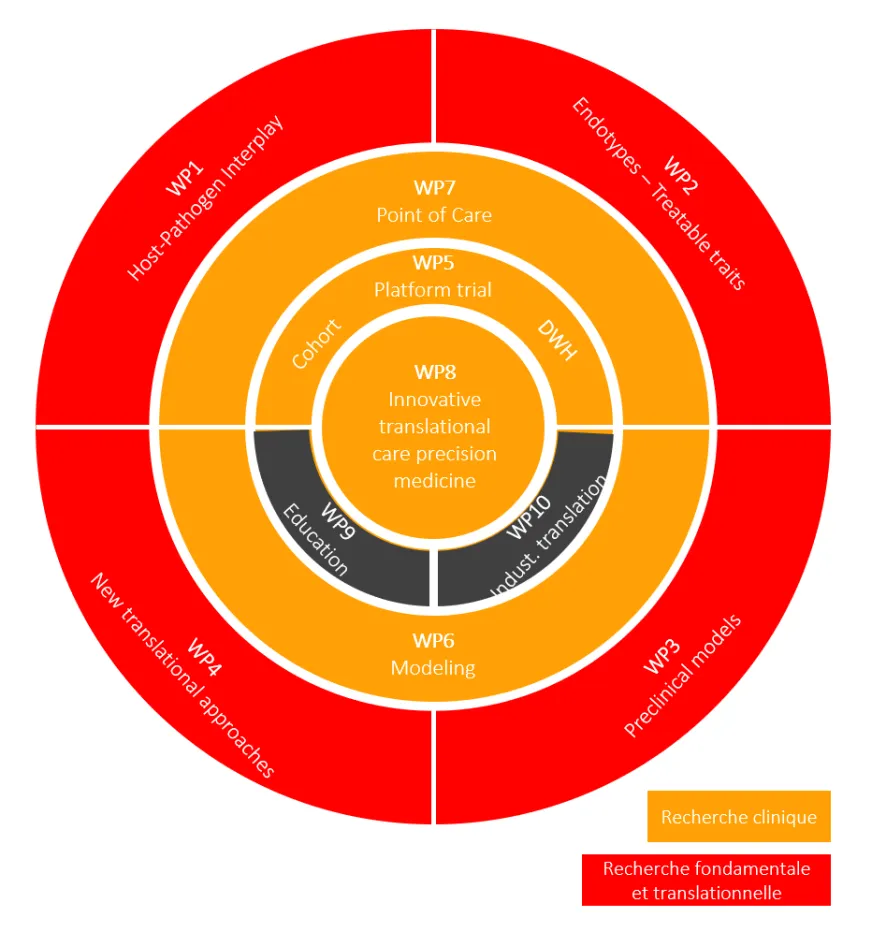
Work Plan
The scientific program is based on an innovative approach to better understand and treat sepsis. It relies on several major pillars:
- Better understand the interactions between the body and infectious agents, in order to explain why patients do not all develop the disease in the same way.
- Identify different types of sepsis (endotypes) and characteristics that can be targeted by specific treatments.
- Develop rapid diagnostic tests capable of providing results in less than 24 hours, in collaboration with industrial partners.
- Connect biological research, patient management, and health system organization to facilitate the integration of innovations into routine care.
To achieve these goals, the program is organized into 10 working groups (Work Packages).
Work Packages (WP)
Leaders: Pascale Serror & Benoît Favier
Refining the characterization of host and pathogen factors involved in immune dysregulation and the microbiome during sepsis through a multidisciplinary approach.
Objectives:
- How do pathogens interact with the host and the microbiota?
- How are the balance points of the immune response dysregulated?
- How do the tissue microenvironment and organ-to-organ interactions influence the breakdown of homeostasis?
Leaders : Véronique Godot & Stanislas Mondot
Translating our knowledge of the molecular mechanisms underlying sepsis into endotype-guided therapies.
Objectives:
- Pathogen-specific biomarkers of disease progression and treatment response.
- Endotyping and treatable traits for the use of corticosteroids.
- Endotyping and treatable traits for immunotherapies – systems biology approaches.
- Endotyping and treatable traits for immunotherapies and treatments targeting the endothelium and coagulation – targeted approaches.
-
Analysis of molecular quantitative trait loci.
Leaders : Nabila Seddiki & Arnaud Mansart
Objectives:
- Establishment and development of experimental models
- Establishment and development of animal models
Leaders : Elias Fattal & Jean-Louis Herrmann
Precision nanomedicine for targeting inflammation and personalized approaches for anti-infective therapies.
Objectives:
- Compartmentalized inflammation
- Vaccine strategy against sepsis
- Microbiota modulation
- Evaluation and monitoring of pathogen transmission
- Rapid identification of pathogens and their antibiotic susceptibility
- Discovery of new antimicrobials and development of biotherapeutic strategies
Leaders : Marie Herr & Nicholas Heming
Identifying patient profiles and trajectories behind general trends in order to develop personalized care pathways and improve survival and quality of life.
Objectives:
- Cohort
- Trial platform
- Data warehouse
Learders : Zaineb Chelly Dagdia-Garcia & Stanislas Grassin-Delyle
Objectives:
- Single-modality analytical signatures to assess patient response and refine biomarkers
- Holistic signature and knowledge integration for biomarker refinement: the digital twin
- Generation of patient profiles – "towards a digital twin"
- Evidence-based selection of potential biomarkers
- Introduction of mechanistic computational models
- Smart healthcare platform
Leaders : Claire Deback, Christophe Junot & Stéphanie Simon
Analytical and organic chemistry, microfluidics, engineering sciences, process engineering, physics, computer science, immunoanalysis, clinical microbiology, immunomonitoring
Objectives:
- Development of laboratory assays for the clinical confirmation of biomarkers
- Development of monoplex POC (Point-of-Care) tests
- Development of integrated POC test platforms
- Assay transfer and industrialization
Leader : Djillali Annane
Objectives:
- Integrated care program and clinical pathway
- From patient to research participant
- Reference center for complex cases
- Active digital platform for registry and follow-up
-
Monitoring the effectiveness of the sepsis care management program
Leader : Olivier Lambotte
Objectives:
- Sepsis training programs and continuing education for healthcare professionals (medical and paramedical)
- Sepsis awareness
- From patient to patient-expert
Leader : Roger Le Grand
Objectives:
- Innovation and industrial transfer
- Knowledge valorization and technology transfer policy
- Organizational structure promoting the valorization and transfer of innovation
- Strategy aimed at promoting partnerships between academia and industry
Leader : Delphine Borgel
Leader : Laëtitia Huiart