On Thursday, September 24, 2026, the “Bridge the Gap” event, organized by Claire Richards and Roland Cahen, brought together 24 biologists, physicians, researchers, professors, and designers to discuss rapid Point-of-Care diagnosis of sepsis.

The day was part of a research project led by Claire Richards, a postdoctoral researcher and lecturer at the Centre for Research in Design (ENSCI-ENS Paris-Saclay), in partnership with l'IHU SEPSIS. It aimed to foster interdisciplinary dialogue around this complex issue and to experiment with a participatory design method to support collective reflection.
The morning sessions first explored the topic of Point-of-Care diagnosis of sepsis, the context of the IHU SEPSIS, existing technologies, as well as hospital design and design research. The workshop then brought participants together in interdisciplinary groups, using dialogue materials specifically designed for the workshop by Claire.
A main fold-out tool (see image above) guided participants through the three stages of the process - framing the problem (left), envisioning (right), and proposing (centre: bridge the gap) - and was complemented by a clinical profile and two sets of thematic cards. During the first stage, the profile served as a starting point for reflection, while a first set of 15 cards enabled participants to select three relevant perspectives to frame the problem. The groups then imagined a desirable future, before using the second set of cards, organized around broad areas for action (education, funding, technology, science, etc.), to identify concrete levers for making this future possible.
The four groups generated numerous ideas and concrete avenues for action, with positive feedback on the contribution of the design research process to renewing approaches to medical research questions. The data collected are now being analyzed to identify emerging themes, the contributions and limitations of the method, potential research avenues to explore further with the IHU SEPSIS, and ways of implementing the method with healthcare professionals in clinical settings.
***
Text written by Claire Richards
Latest news
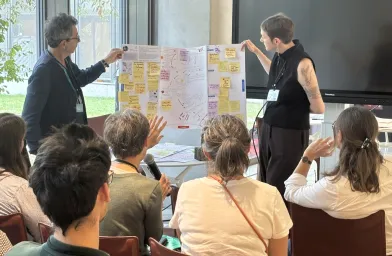
On Thursday, September 24, 2026, the “Bridge the Gap” event, organized by Claire Richards and Roland Cahen, brought together 24 biologists, physicians, researchers, professors, and designers to discuss rapid Point-of-Care diagnosis of sepsis.
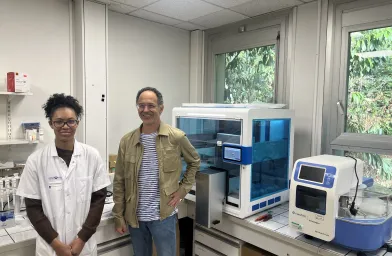
Maëlisse is a PhD student at MICALIS, INRAe. To gain a better understanding of the reality of sepsis in a hospital setting, she swapped her researcher’s lab coat for a clinical one for a week of shadowing in the Intensive Care Unit at Raymond-Poincaré Hospital in Garches.