On the occasion of World Sepsis Day on September 13, the IHU SEPSIS, at the initiative of the DETECSEPS consortium - comprising the Hospices Civils de Lyon (HCL), Assistance Publique - Hôpitaux de Paris (AP-HP), and industry partners IDS France (Immunodiagnostic Systems) and Volition (Belgian Volition SRL) - officially announces the launch of its project dedicated to the early detection of sepsis.

A new strategy for earlier sepsis detection
The project has been selected as a winner of the Challenge Prévention call for projects, launched by the French Health Innovation Agency (Agence de l’innovation en santé, AIS) and operated by Bpifrance, as part of the France 2030 investment plan. It aims to transform the early detection and triage of patients presenting to emergency departments with suspected infection.
Sepsis is a dysregulated response of the body to an infection, responsible for the failure of one or more organs and which can quickly become life-threatening. Worldwide, it is estimated that this pathology is responsible for 21 million deaths per year1. Rapid detection is therefore crucial to improve care and reduce mortality.
The DETECSEPS program aims to identify on arrival into the Emergency Department which patients with suspected infection are at risk of developing sepsis and require hospital care and which patients can be safely redirected home.
The objective is to allow earlier care and a more accurate referral of each patient.
Initiated by the IHU Sepsis, directed by Professor Djillali Annane of the Raymond-Poincaré Hospital AP-HP, DETECSEPS brings together within the same consortium the AP-HP, the project's coordinating institution and sponsor of the clinical trials, the Hospices Civils de Lyon and the industrial partners IDS France and Volition.
The strategy is based on an innovative combination:
- The National Early Warning Score (NEWS) 2 clinical score to quickly assess the patient's condition upon arrival at the emergency department.
- Volition's blood biomarker Nu.Q® NETs H3.1, capable of quantifying NETosis, an immune mechanism linked to sepsis.
- The i10 device from IDS to automate the Volition biomarker for a quick and accurate result.
With government funding of €6.3 million, DETECSEPS will evaluate this strategy in 1,000 patients in real-life care settings. If the results are conclusive, this approach could profoundly change the journey of patients consulting for suspected infection by speeding up the care of those at risk, avoiding hospitalizations and improving the fluidity of emergency services. Its large-scale deployment could also help reduce the socio-economic costs and environmental impact associated with care pathways.
1 Gray, Authia P et al. Global, regional, and national sepsis incidence and mortality, 1990–2021: a systemic analysis. The Lancet Global Health, 2025; 13(12): e2013-e2026. doi: 10.1016/s2214-109x(25)00356-0
Latest news

On Thursday, September 24, 2026, the “Bridge the Gap” event, organized by Claire Richards and Roland Cahen, brought together 24 biologists, physicians, researchers, professors, and designers to discuss rapid Point-of-Care diagnosis of sepsis.
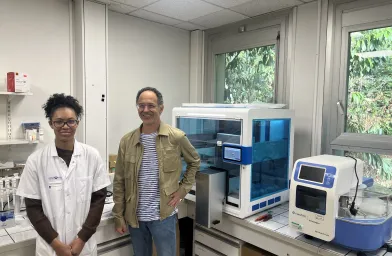
Maëlisse is a PhD student at MICALIS, INRAe. To gain a better understanding of the reality of sepsis in a hospital setting, she swapped her researcher’s lab coat for a clinical one for a week of shadowing in the Intensive Care Unit at Raymond-Poincaré Hospital in Garches.